
Last updated: November 2026
Short answer: the Great Green Macaw Signature Session is a natural-light session dedicated to one of the rarest large parrots in the Americas, photographed in the northern Caribbean lowlands of Costa Rica. Physis includes it all year in private programs that visit the Boca Tapada region. Depending on the time of year, the session visits private farms where nest trees or fruiting mountain almond trees have been identified. Sightings of a wild, Critically Endangered bird are never guaranteed.
Session at a glance
| Details | |
|---|---|
| Subject | Great Green Macaw (Ara ambiguus) |
| Technique | Natural light with a long lens: perched portraits, feeding behavior and birds in flight |
| Region | Northern Caribbean lowlands (Boca Tapada area) |
| Season | All year; nest trees or almond trees, depending on the time of year |
| Conservation status | Critically Endangered (IUCN Red List) |
| Included in | Private Physis programs; not sold separately |
| Level | All levels; flight images reward practice with autofocus tracking |
Why is the Great Green Macaw a special subject?
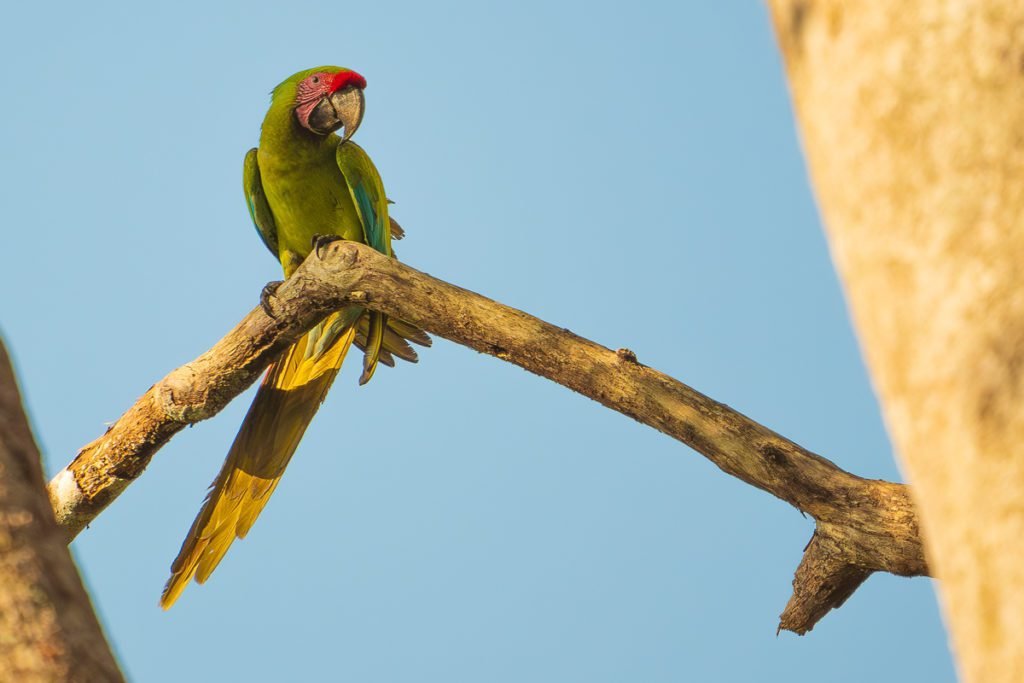
The Great Green Macaw is a very large, mostly green macaw with a red forehead, blue flight feathers and a long red-and-blue tail. The IUCN Red List has classified it as Critically Endangered since 2020, with an estimated 500 to 1,000 mature individuals left across its range from Honduras to Ecuador.
In Costa Rica the species lives in the humid lowland forest of the northern Caribbean slope, where it depends heavily on the mountain almond tree for both food and nesting cavities. For a photographer, that means the opportunity is tied to a specific region and to what the trees are doing, not to a fixed stage that works the same way every day.
Where does the session take place?
The session takes place on private farms in the Boca Tapada region of the northern lowlands, close to the Maquenque National Wildlife Refuge, an area protected in large part because of this macaw. The region is remote, so Physis plans it as a stay of several nights. That gives room for a second attempt if weather or bird movement does not cooperate, and it combines naturally with the King Vulture Signature Session in the same part of the country.
How does a session work?
The session runs all year, and the time of year decides where it goes. In some months it visits farms where active nest trees have been identified; in others it visits farms with fruiting mountain almond trees where the macaws come to feed. The birds usually move in pairs or small family groups, and their loud calls often announce them before they come into view. There are typically two kinds of image to work on: perched and feeding birds in the canopy, and birds in flight as they arrive or leave.
- Perched and feeding: watch for interaction between pairs and for birds handling fruit; expose for the green plumage against a bright sky.
- In flight: the upperwing and tail show the strongest color, so a position with the light behind you matters more than getting close.
- Environmental frames: a wider view of the bird in a large rainforest tree tells the conservation story better than a tight portrait alone.
Add the Great Green Macaw session to your program
Physis designs private photography programs in Costa Rica around the sessions you choose, with the right region, timing and light. Tell us which Signature Sessions you want in your private program. Private programs start from US$4,000.
What equipment and settings do I need?
| Field need | Practical starting point |
|---|---|
| Reach | A 400–600 mm lens, or a 100–500 mm or 200–600 mm zoom for flexibility when birds fly closer |
| Flight | 1/2000 s or faster, continuous autofocus with subject tracking, and a high frame rate |
| Perched birds | A slower shutter speed and lower ISO are possible; a monopod or tripod helps during long waits |
| Exposure | Green birds against bright sky fool the meter; check the histogram and add exposure compensation as needed |
| Weather | Rain cover for camera and lens; the lowlands are hot and humid, with showers at any time of year |
Flash is not used in this session. For a wider packing list, see what camera gear to bring to Costa Rica.
How does Physis photograph an endangered species responsibly?
The birds set the distance. Sessions work from positions that do not block flight paths, keep a respectful distance from nest trees, and never use playback or food to move a bird for a photograph. If the macaws change their behavior, the session moves back or ends. This is the same approach described in our guide to ethical bird photography.
Frequently asked questions
Are Great Green Macaw sightings guaranteed?
No. This is a wild, Critically Endangered bird that moves with the fruiting of forest trees. Staying several nights in the region and working with current local information improves the opportunity, but no honest operator can promise a sighting.
When is the best time to photograph Great Green Macaws?
The session runs all year. What changes is the setting: depending on the time of year, it visits farms with identified nest trees or farms with fruiting mountain almond trees. Tell us your travel dates and Physis will advise what to expect at that time of year.
Can I book this session on its own?
No. Signature Sessions are included in private Physis programs and are not sold separately. The Great Green Macaw session is usually part of a program that spends several nights in the northern lowlands.
Related pages
See all Signature Sessions
Combine great green macaws with king vultures, quetzals, hummingbirds, night macro and more in one private program.